Technical leadership in this area is led by
Dr. Xiaola Ma
of the Georgia Tech ECE school. In their first year (2009-2010) Dr. Ma, staff and
international collaborators have authored four
publications.
Current research efforts emphasize design and implementation of
optimal UWB detectors.
UWB High Power Antenna DT&E
Implementations of UWB apertures will sometimes require high power
waveforms to be used. High power UWB designs, leading to manufacture
and demonstration, of an apertures and arrays are in a embryonic
state. Prior UWB antenna design techniques are the beginning. High
power UWB technologies are ripe areas for collaborative research.
Research topics are multidisciplinary and will include: design code
modification and development; materials research; feed structure
design; waveform synthesis; development of measurement facilities
and assembly of computational resources for multiscale modeling.
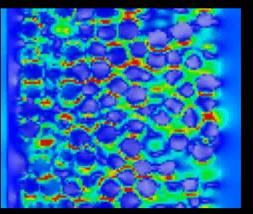
FDTD computed simulation of UWB interaction with semiconducting particle composite
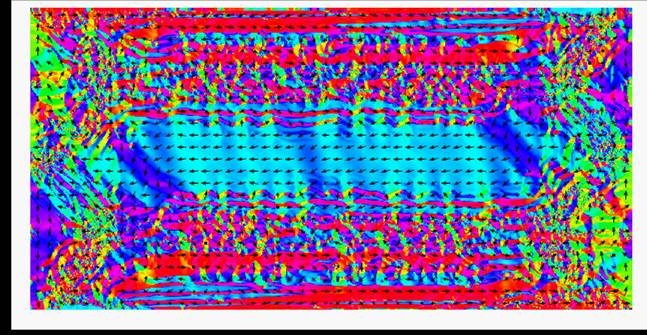
Computed Simulation of UWB interaction with magetic particle
In the past 10 years extensive study has been made in modeling,
formulation and manufacture of nano and microscale dielectric,
conducting and magnetic materials and their composites. Propagation
and scattering of UWB electromagnetic signals in these new, small
scale particles and their composites is being performed by UWBTech.
Advances in numerical simulation and materials modeling can
facilitate exotic interactions to be studied in detail at the nano,
microscale and composite scales. These include nonlinear phenomena
that may be encountered in diverse technical fields. Personnel of
UWBTech will build upon simplified analytical and complex numerical
simulations that suggest UWB (and/or high power UWB) propagation and
scattering of semiconducting and magnetic can produce material
nonlinear response. Example simulations are shown in the movie frames
on this page. In the first a UWB waveform is shown propagating through
a random composite composed of semiconducting nanoparticles in a
dielectric matrix. Mutual scattering of the particles lead to extreme
magnitude fields indicated by red color) that are located near the
scatterers which can intern lead to nonlinear response of some
materials positioned near the particle interfaces. The phenomena has
been observed and leveraged in Surface Enhanced Raman Scattering.
The second frame illustrates modification of magnetic domains within a
rectangular ferromagnetic nano scale particle when it interacts with a
UWB high power waveform. Domain structure is distorted with a resulting
change in effective magnetic permeability and an inferred change in
composites that would contain these magnetic partiles. Thereby
electromagnetic reflection, transmission and absorption of the
composite would be modified from its expected low power values.
Nanoparticle Nonlinear Magnetics (NPNM)
Non-Linear Materials Interactions
The UWB Coe is actively engaged in modeling and measurement of UWB interactions
with nanometer scale particulates, semiconductor and magnetic quantum dots,
composites of these particulates and combinations of nano particles - photonic
bandgap (PBG) structures and/or plasmonic surfaces/materials. PBG and plasmonic
surface are of particular interest since they contain volumes where very large
EM fields are localized. The left most simulation visualizes the coupling of an
UWB pulse with a fragmented plasmonic surface. The two right movies visualize
UWB EM field interactions with two nano particulate composites (one high volume
fraction and one low volume fraction). The particulates have Drude like EM
properties. Note that high field strengths are indicated in red while low fields
are toward the blue. Additional studies are ongoing to predict magnetic domain
structures and EM response in magnetic nano dots.